

Description
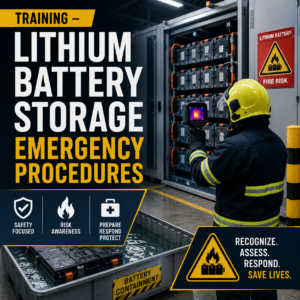
Training – Lithium Battery Storage Emergency Procedures
Lithium batteries are used in a wide range of modern applications, from consumer electronics and power tools to e-mobility, industrial equipment and energy storage systems. Although these batteries are highly efficient, their storage can present serious safety risks when they are damaged, defective, unstable or improperly handled. Incidents involving lithium batteries can develop rapidly and may lead to thermal runaway, fire, explosion, toxic gas release and contaminated extinguishing or cooling water.
The training Lithium Battery Storage Emergency Procedures provides participants with a clear understanding of the main hazards associated with the storage of lithium-ion and lithium polymer batteries. The course explains how incidents can develop, which warning signs may indicate an unstable battery, and what emergency measures should be taken to reduce risks to people, property and the environment.
The course consists of two modules. The first module focuses on the theoretical background of lithium battery safety. Participants learn about battery types, state of charge, thermal runaway, gas formation, damaged or defective batteries, contaminated cooling water and the importance of proper storage arrangements. The module also explains why early recognition of abnormal conditions is essential in preventing escalation.
The second module is more practice-oriented and focuses on emergency procedures and realistic scenarios. Participants are introduced to practical situations that may occur in warehouses, cross-dock operations, storage areas or industrial facilities. These scenarios help participants recognise damaged packaging, assess unstable energy carriers, understand when batteries should be isolated, and determine which actions should be taken during an emergency.
Special attention is given to the importance of clear procedures, correct storage decisions, fire compartmentation, the use of suitable packaging for damaged or defective batteries, and the safe handling of contaminated water or residues after an incident. The course also highlights the need to follow manufacturer instructions and to use appropriate detection methods, such as temperature monitoring or thermal imaging, where relevant.
This training is suitable for employees, supervisors, warehouse staff, safety professionals and emergency response teams who are involved in the storage, handling, inspection or emergency management of lithium batteries.
After completing the course, participants will have a better understanding of the risks associated with lithium battery storage and will be better prepared to recognise, assess and respond to potential emergency situations.
Key learning outcomes
After completing this training, participants will be able to:
- Understand the main hazards of lithium batteries in storage;
- Explain the concept and risks of thermal runaway;
- Recognise indicators of damaged, defective or unstable batteries;
- Understand the role of State of Charge in incident severity;
- Identify practical measures for safe storage and segregation;
- Respond more effectively to lithium battery storage incidents;
- Understand the importance of contaminated cooling water management;
- Apply emergency procedures in practical storage scenarios.
Who should attend?
This training is intended for anyone involved in lithium battery storage or emergency response, including warehouse employees, logistics personnel, safety officers, supervisors, facility managers and members of company emergency response teams.
Language: English
Practical and safety-focused
The course combines essential theoretical knowledge with practical examples and scenario-based learning. This makes the training suitable not only for gaining awareness, but also for improving the practical response capability of organisations that store or handle lithium batteries.
Test and certificate
At the end of the training, participants complete a short test to check their understanding of the course content. To successfully complete the training, participants must achieve a minimum score of 70%. Upon successful completion, the participant receives a Certificate of Participation.


Reviews
There are no reviews yet.