
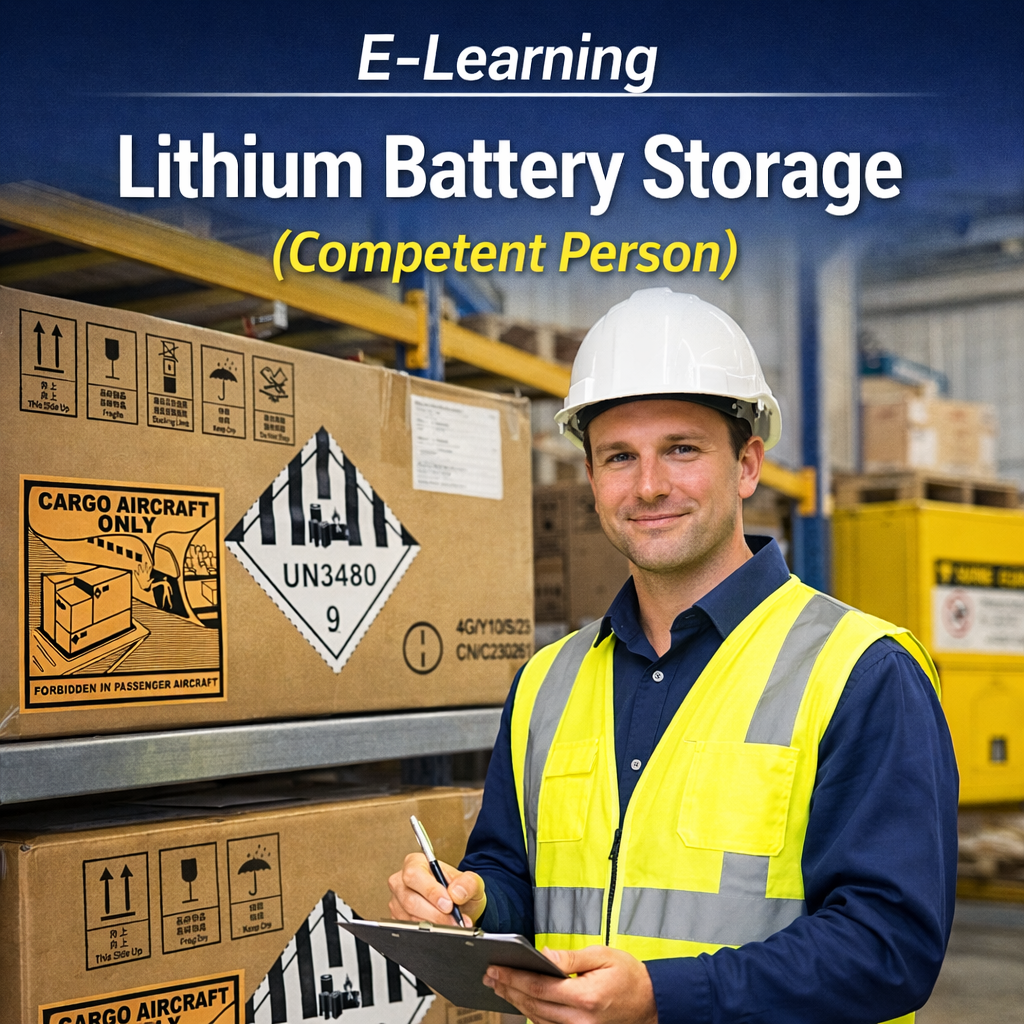
Description
International Lithium Battery Storage Safety Course (Competent Person) – English
Reduce Fire Risk – Implement International Best Practices – Improve Lithium Battery Storage Safety
Lithium batteries are stored worldwide in warehouses, distribution centers, production facilities, and e-commerce operations. While lithium batteries are essential for modern industry, they also present significant fire risks when stored incorrectly. Incidents involving lithium batteries often lead to severe fires, major financial losses, and operational downtime.
The International Lithium Battery Storage Safety Course (Competent Person) is designed for professionals responsible for the storage, handling, and safety management of lithium batteries within warehouses and storage facilities. The course focuses specifically on the safe storage of lithium batteries based on internationally recognized best practices, including the best practice guidance as proposed by the International Fire & Chemical Logistics Association (IFCL).
The course provides practical and risk-based safety measures that organizations can implement to reduce the risk of lithium battery fires and incidents in storage environments.
Course Structure – 4 Modules
The course consists of four modules:
Module 1 – Risks and Storage
This module explains the risks of lithium batteries, including thermal runaway, fire hazards, damaged batteries, and incorrect storage conditions.
Participants are introduced to lithium battery risk profiles and storage categories, including the use of typicals and risk-based storage classification. This module forms the foundation for safe lithium battery storage management.
Module 2 – Measures and Scenarios
This module focuses on practical safety measures and storage scenarios.
Participants learn how to implement safety measures such as segregation, storage zoning, fire protection, handling procedures, and risk reduction measures. Different storage scenarios are discussed, including small storage, large warehouses, returns handling, and damaged battery storage.
Module 3 – Shipping Lithium Batteries
This module explains the relationship between storage and transport regulations.
Participants learn the basics of shipping lithium batteries by road, sea, and air, including UN numbers, damaged batteries, packaging, labeling, and the differences between storage and transport regulations. This module ensures that storage operations and shipping activities are aligned and compliant with international transport regulations.
Module 4 – Incidents and Safe Conduct
This module focuses on incident recognition, emergency response, and safe behavior in case of lithium battery incidents.
Participants learn how to recognize early warning signs, what to do in case of overheating batteries, how to respond to lithium battery fires, and how to protect employees and emergency responders. The module also covers evacuation, communication with fire services, and post-incident procedures.
Competent Person
After completing this course, participants have the knowledge to act as a Competent Person for Lithium Battery Storage Safety within their organization. This means the participant understands the risks, required safety measures, and best practices for the safe storage and handling of lithium batteries and can support the organization in improving lithium battery storage safety.
Target Audience
This course is intended for:
- Warehouse managers
- Logistics managers
- Safety managers
- EHS managers
- Dangerous Goods Safety Advisors (DGSA)
- Facility managers
- Fire safety coordinators
- Employees responsible for lithium battery storage and handling
Language: English
Important Notice
This course is based on international best practices for the safe storage of lithium batteries, including guidance from the International Fire & Chemical Logistics Association (IFCL). However, this course does not guarantee full compliance with local laws or regulations, which may differ by country, region, or authority.
Completion of this course does not guarantee that incidents, fires, or accidents will not occur within an organization. The responsibility for implementing safety measures and creating a safe storage environment remains at all times with the company and its management.
It is the responsibility of each organization to assess its own risks and to implement appropriate safety measures based on its specific activities, storage volumes, local regulations, and risk assessments.


Reviews
There are no reviews yet.